AI GOVERNANCE
Our AI proposes, Your people decide.
The AI Governance module of VerityAI™ puts your agency in direct authority over the AI it depends on. The model learns automatically from your team's confirmations and corrections. Your agency decides what goes into use, and each decision is recorded when it is made.
Three questions every AI purchase now faces
Public agencies are asked the same three things about any AI they buy. We answer them in the product.
Who is accountable for what the AI does?
A named person. Our AI proposes; a member of your team decides, and the record shows who.
How does it improve without drifting?
It learns automatically from your team's judgments, checks itself against independent benchmarks, and goes into use only with your agency's approval.
Can you prove it to an auditor?
Yes. Each approval is recorded as it happens, so the audit record comes from the decisions themselves.
AI inference never overrides law or observation.
Every finding VerityAI™ produces rests on three layers, each held to a different standard of trust. AI inference sits at the top, and it is the layer we trust least.
Trusted least
AI inference
What the model concludes: a classification, a match across cameras, a pattern across sources.
Holds because
A person can always correct it, and it always traces back to the observation and the rule behind it. Its conclusions never change a record of what happened, or a rule.
Recorded
Observed signal
What was actually recorded: camera and sensor feeds, dispatch and records systems, public data. Timestamped and auditable.
Holds because
It can be noisy or incomplete, but it is never invented. Every inference above points back to a specific observation here.
Trusted most
Law and policy
The rules an agency already operates under: statutes, ordinances, and department procedures. Not inferred, and not open to debate.
Holds because
No part of VerityAI™ operates outside it, and no sensor reading or model output ever rewrites it.
Each layer depends on the one below it. Nothing in the system edits a record of what happened, or a rule it did not write.
Learning is automatic. Going live is not.
VerityAI™ improves continuously from the people who use it. Your agency keeps authority over what goes into use.
- 01Your team confirms or dismisses
- 02Unclear cases are picked for review
- 03Labels are checked by agreement
- 04The model retrains automatically
- 05Learning is shared, data stays in your custody
- 06Benchmarks check for drift
- 07Your agency decides what goes liveAn update goes into use only when your team approves it or it meets rules your team has set. The decision is recorded.

An update waiting at the gate.
- 01What it learned from: your team's confirmations and corrections
- 06Benchmark results, including the drift check
- 07Approve or decline: your agency decides
Trust you can check
Each promise comes with the mechanism that enforces it.
Auditable
Every approval is recorded when it is made: who authorized what, and why.
Enforced by
Unapproved models are refused. Every model carries an identity, and VerityAI™ can be set to block any model that has not passed our governance checks.
Private
Your data stays in your custody, on your infrastructure, under your rules.
Enforced by
Federated learning shares only what the model learned. Training data passes quarantine and consent checks, and each model records its sources.
Explained
Every finding shows its sources, its confidence, and what it could not determine.
Enforced by
Labels come from agreement across several independent models, so one model's mistake is less likely to become training data.
Every approval, on the record
Here is what one approval leaves behind, ready to share with an auditor, a council, or the public.
Approval record
Sample- Decision
- Model update approved for use
- Approved by
- M. Alvarez, Operations supervisor
- Basis
- Passed drift benchmarks; staff review complete
- Learned from
- 1,204 confirmed and 188 corrected examples
- Sources
- Video, work orders, resident reports
- Recorded
- 2026-10-21 09:42:07 ET
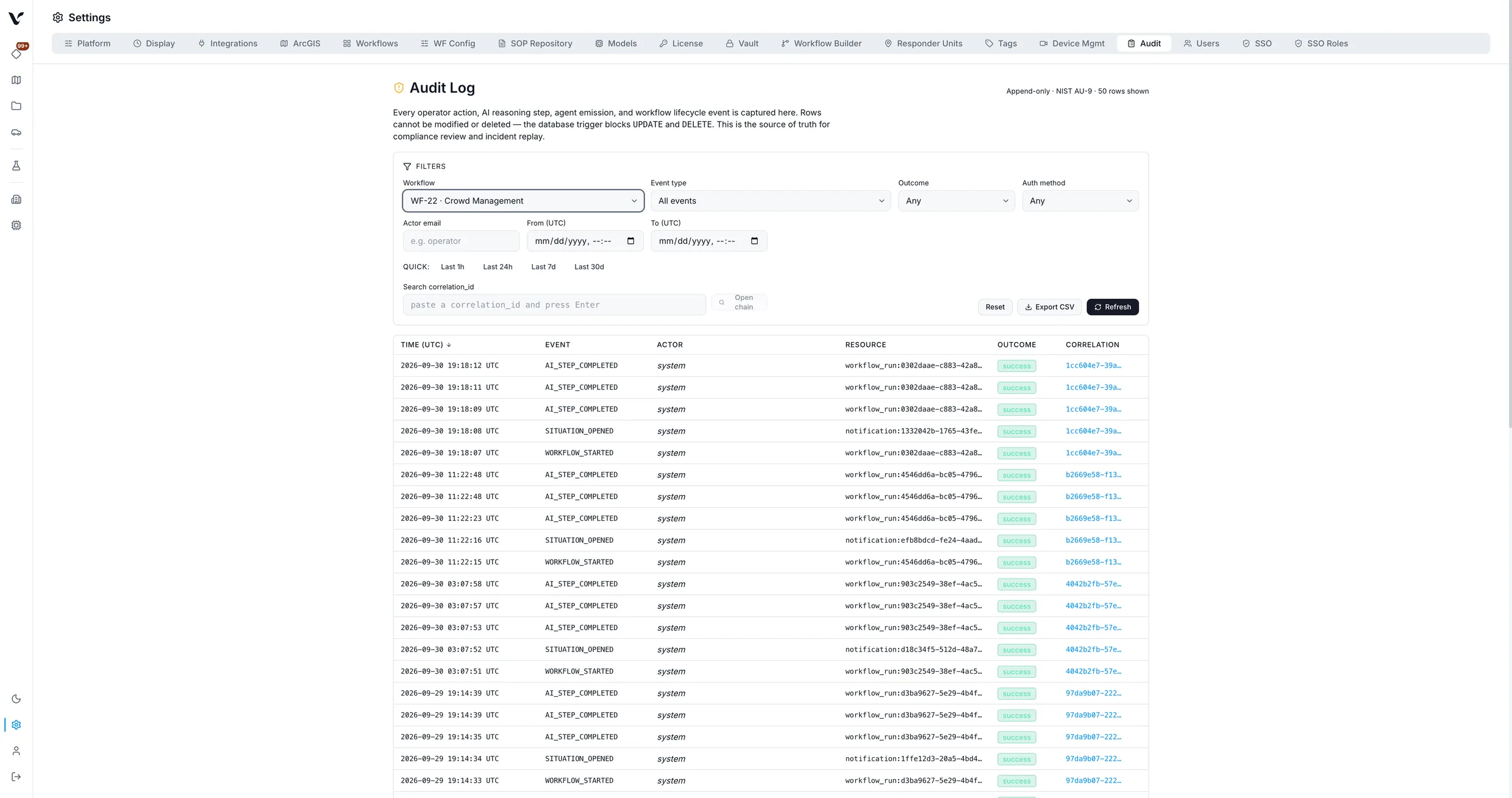
The audit log in VerityAI™. Append-only: the database refuses updates and deletes, so the record is the one the system wrote at the time.
- FilterBy workflow, event type, outcome, actor and time window
- RowsEvery operator action, AI reasoning step, agent emission and workflow event, with its actor, resource and outcome
- ChainA correlation id opens the whole sequence behind one situation, for compliance review and incident replay
Governance at every level of the agency
Governance starts where the work happens and reaches everyone who has to answer for it.
Operators and analysts
Confirm or dismiss what the model flags. The model learns from their judgment automatically.
OperateSupervisors and governance leads
Set the rules for updates and decide whether a new model goes into use.
GovernAuditors, councils, and oversight bodies
Review a record of who approved each change and why, created at the time and ready to share.
Oversee
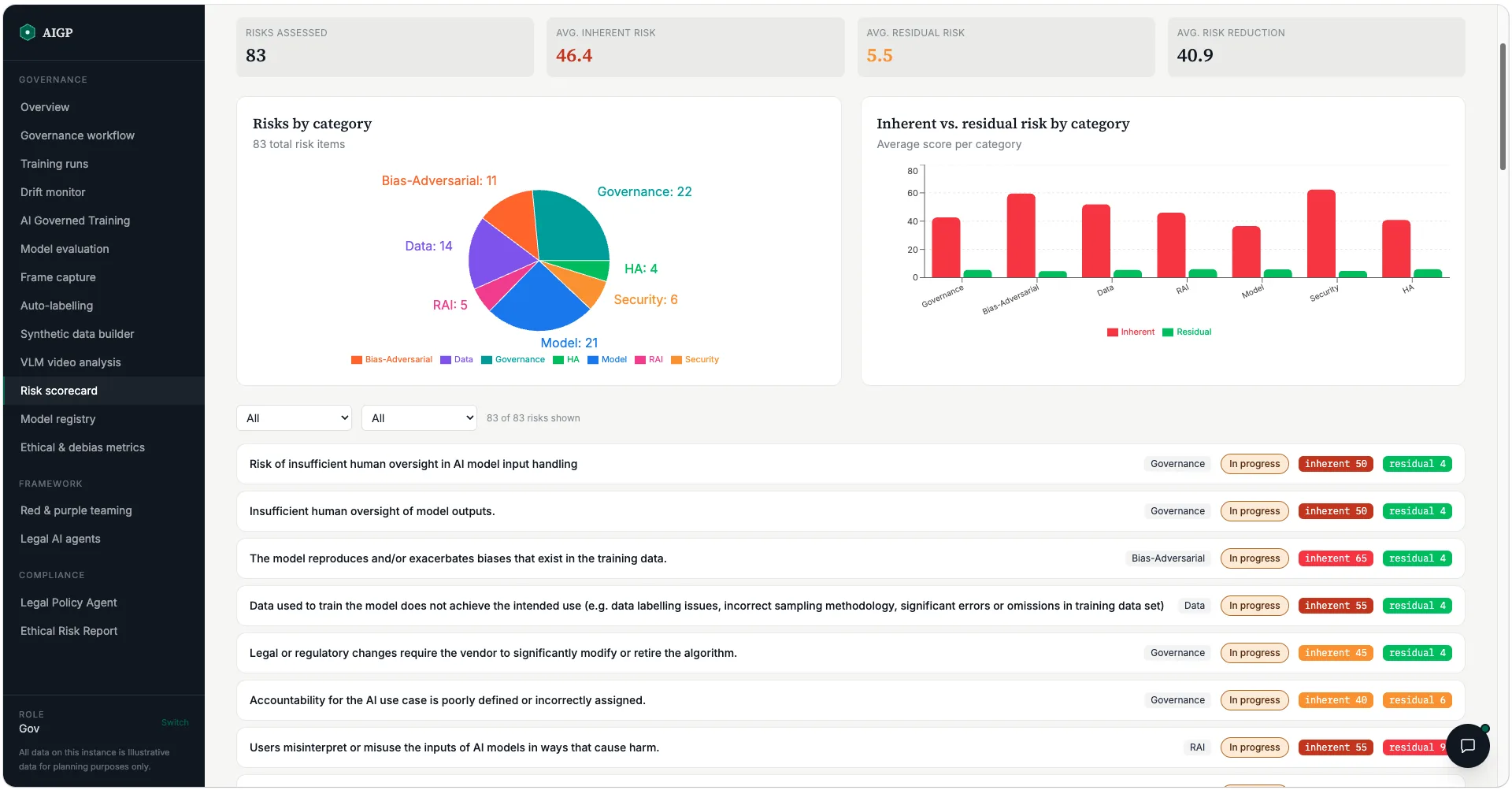
The risk scorecard in the AI Governance platform, as a governance lead sees it. Illustrative data.
- 183 risks by category: governance, model, data, bias, security, responsible AI and human agency
- 2Inherent against residual risk, averaged per category: 46.4 to 5.5 across the register
- 3Each risk with its category, its status and both scores, owned by a named role
Common questions
Can the AI change its own models?
It learns and retrains automatically. An update goes into use only after it passes independent benchmarks and people your agency authorizes approve it, or it meets rules they have set.
How do you stop it from drifting?
Every update is tested against independent benchmarks, including a check that the system has not learned to flag less just because fewer alerts were confirmed.
Does it cover more than video?
Yes. The same loop works across every source VerityAI™ connects. Automatic labeling covers our first detection classes today, with more being added.
Is AI Governance a separate product?
It is a module of VerityAI™, built into the platform rather than added on.
Do you publish accuracy improvements?
Only once the product measures them for every update. Until then, we would rather give you none than give you a guess.
Is it certified?
Not yet. We can show you the audit record itself. Third-party attestation is still ahead of us, and we will say so plainly until it is done.
Watch governance work.
In a briefing, we run the learning loop on screen, from a flagged event to an approved model update.