VERITYAI™
One picture of the situation. A named person decides.
VerityAI™ brings together the information an agency already holds, from work orders and dispatch systems to cameras, sensors, and public data. It shows the evidence, states its confidence, and leaves every decision with a person.
What agencies use VerityAI™ for
Every area runs on the same platform and the same data, so what one department sees can help another.
Roads and infrastructure
Potholes, track defects, and bridge damage, turned into work orders.
Environment and resilience
Smoke, fire, and flooding in tunnels; early warning at substations.
Cleanliness and city services
Illegal dumping, graffiti, and spills, sent to crews by need.
Transit and traffic
Bus bunching, toll queues, and roadway incidents.
Worker and facility safety
Protective gear, equipment near-misses, and after-hours intrusion.
Public safety and emergencies
A person down, items left behind, people on the tracks, crowding.
Investigations
Plain-language video search; hours of footage summarized in minutes.
Reporting and communications
Call summaries, draft reports, service notices, and briefings.
Built with agencies in
- Cities and counties
- Police, fire, and EMS
- Real-time crime centers
- Transit
- Transportation
- Airports
- Corrections
VerityAI™ surfaces. A person decides.
A person has five senses. VerityAI™ has 65. It reads cameras, sensors, records, radio and public feeds together, as one body of evidence, so it takes in far more of a situation than any one person could.
Then it does the harder part: it turns all of that into something a person can grasp in seconds. Every finding shows where it came from, how confident the system is, and what it could not determine. When a decision has to be fast, the person responsible still sees the reasoning, and still makes the call.
- 01A signal arrivesA camera on a bridge approach sees new surface damage.
- 02Evidence is gatheredVerityAI™ checks work orders, overnight weather, and resident reports for the same spot.
- 03Confidence and gaps are shownThe finding states how confident the system is and names any input that was poor or missing.
- 04A second model checks itA separate AI model reviews the finding before it reaches a person.
- 05A person decidesA maintenance supervisor decides whether to send a crew. Nothing happens without that decision.
- 06The record is keptThe finding, its evidence, and the decision are stored together for later review.
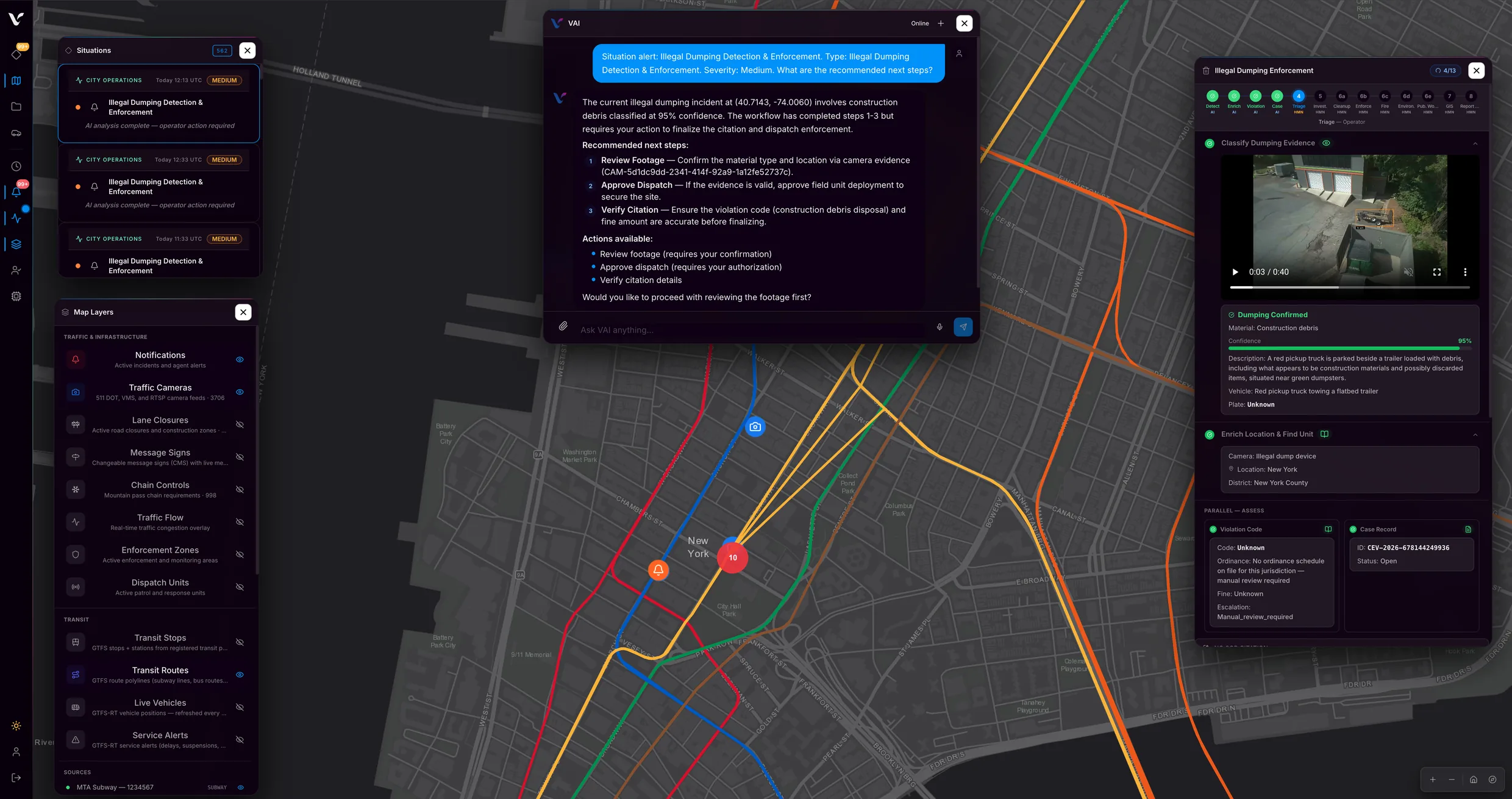
The same kind of finding in VerityAI™, here an illegal dumping case. Illustrative data.
- 1The evidence: the camera clip, the camera named, the location and district
- 2Confidence, 95%, and what it could not determine: the plate and the ordinance, both sent to manual review
- 3Four AI steps done, detect, enrich, violation and case, each recorded before the operator's step
- 4The operator's actions: review the footage, approve the dispatch, verify the citation, each needing a person's confirmation
The Operational Intelligence Layer
VerityAI™ sits over the systems an agency already runs, reads across all of them, and gives every team the same picture.
Your teams
- Operations centersSee the situation
- Maintenance crewsGet the work
- InvestigatorsFind the evidence
- Agency leadersBrief and decide
- Systems of recordDispatch, records, work orders
- Audio and videoCameras, drones, 911 audio
- SensorsIoT and telemetry
- Public dataOpen records and feeds
- Tips and reportsLabeled by source
- EnvironmentWeather, water, hazards
- Maps and imageryGeospatial and satellite
- Unit locationsVehicles and crews
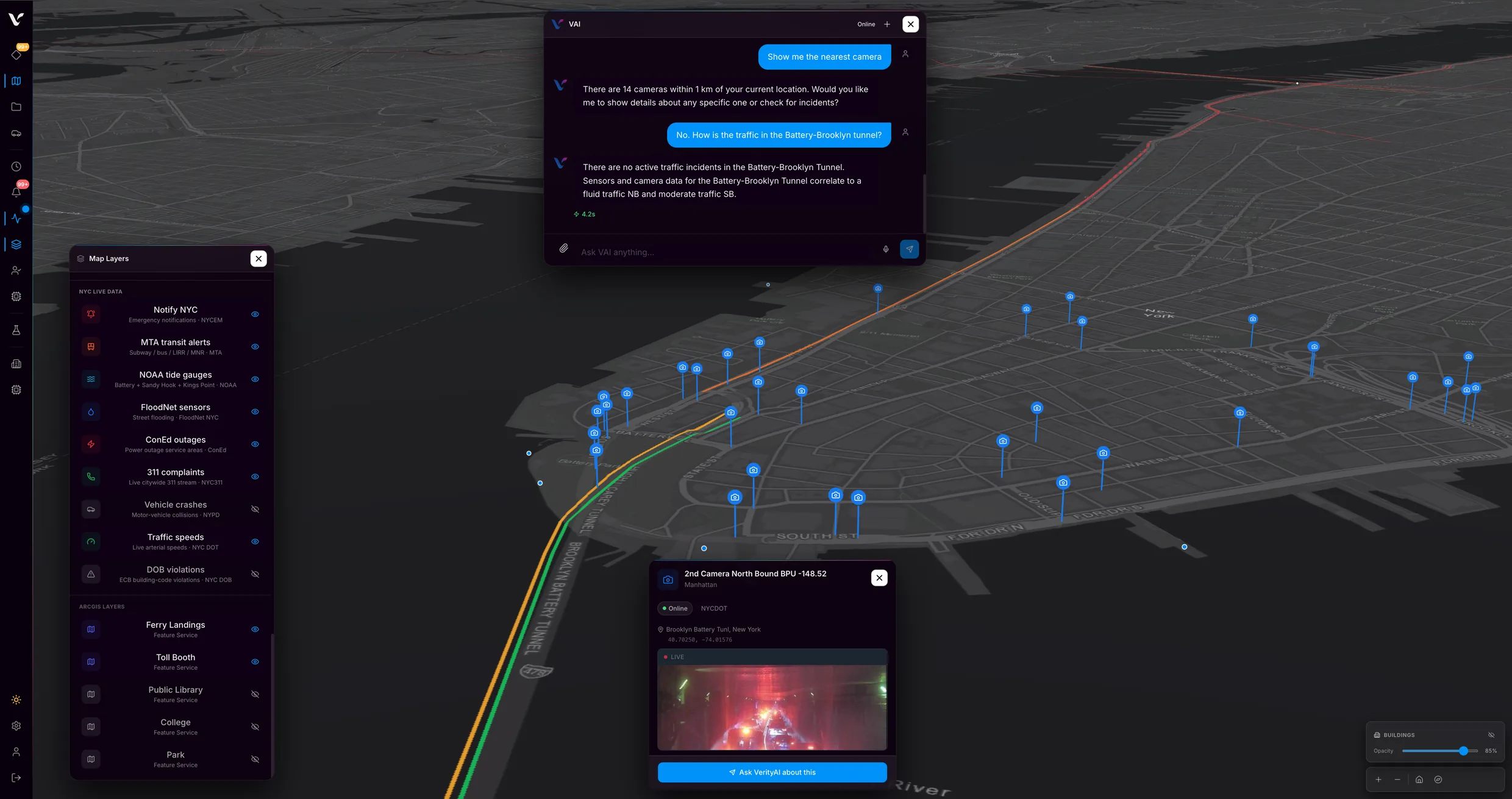
One map, many systems. Each layer comes from the agency that publishes it. Illustrative data.
- LayersEmergency notices, transit alerts, tide gauges, flood sensors, outages, 311 calls, crashes, traffic speeds and building violations, each live from its source
- CameraA live tunnel camera, opened from its pin on the map
- AskA question in plain language, answered from the platform's own sensor and camera data in 4.2 seconds
Governed by design
VerityAI™ learns from every confirmation your team makes and shares what it learns across deployments, so each deployment makes the next one better. Your evidence never leaves your custody.
An update goes into use only when your agency approves it, and every decision is recorded. Every finding points back to a specific observation and stays inside the rules that already govern the agency.
Every case, on the record
Each case shows who gathered the evidence, what checked it, who decided, and what the analysis cost. It is ready for review the moment it closes.
Case record
Sample- Case
- New pothole, eastbound bridge approach
- Assembled by
- Evidence agent: camera, work orders, weather, two resident reports
- Reviewed by
- Verification agent: agrees, one camera view partly obscured
- Decided by
- R. Chen, Maintenance supervisor
- Recorded
- 2026-10-21 07:58:12 ET, before the crew was sent
- Models and cost
- 3 models, $0.41 of analysis
- Export
- Versioned case file, ready for review
How agencies start
- 01
A briefing
We look at your systems, your security requirements, and the problem you most want solved.
- 02
One workflow, one site
Start where results are easiest to see, such as potholes, illegal dumping, or video search.
- 03
Expand
Add sources, sites, and teams. What VerityAI™ has learned carries over.
Common questions
Is VerityAI™ only for public safety?
No. Agencies use it for infrastructure, maintenance, cleanliness, transit, traffic, and reporting, as well as public safety.
Does VerityAI™ make decisions?
No. It raises issues and shows the evidence. A named person decides and takes any action.
Do we have to replace our current systems?
No. VerityAI™ reads across the systems you already run.
Where does our data live?
In your custody, on infrastructure you control. When VerityAI™ learns, only what the model learned is shared.
Is VerityAI™ CJIS compliant?
CJIS compliance is assessed for each agency's deployment, so no vendor can claim it alone. VerityAI™ is designed to support agencies in meeting the FBI CJIS Security Policy.
How long does it take to start?
Most agencies begin with one workflow at one site. We set the timeline together in the first briefing, based on the systems involved.
See it with your own systems.
The most useful first conversation starts with what your agency already runs.